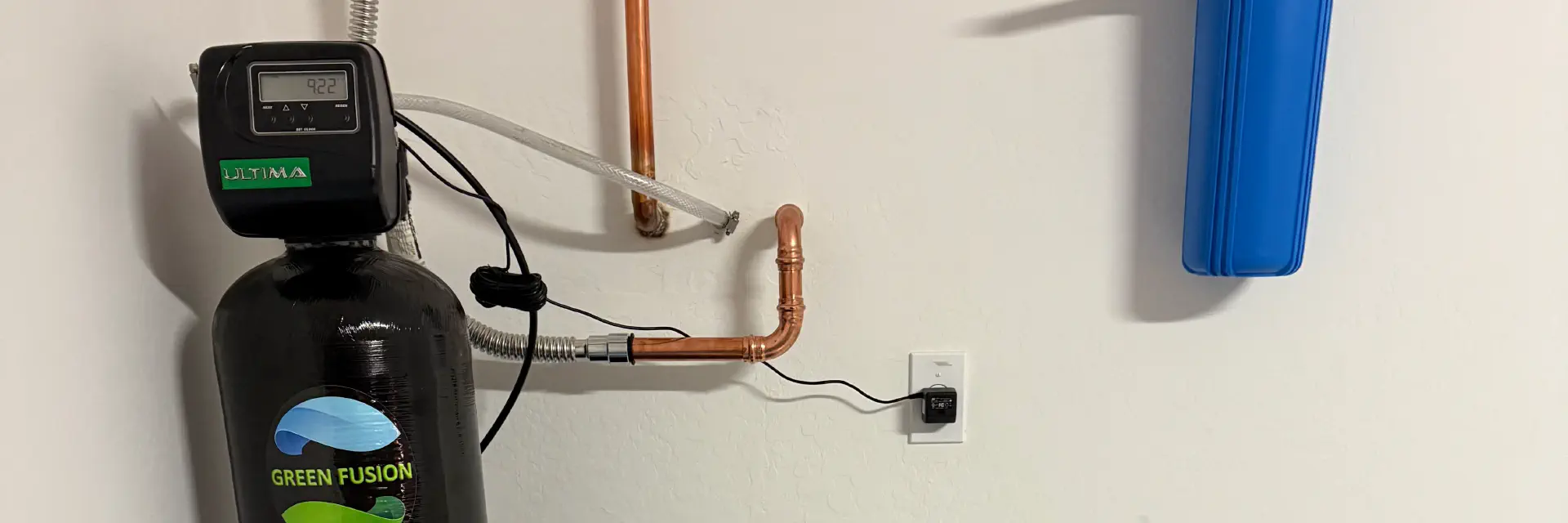
Whole Home Water Filtration for the East Valley
Contaminants
Your water is hard, chlorinated, and contaminated with agricultural runoff. Here’s the data. Thanks to regulations, each of our cities performs up to 100 water tests per day from public and private taps all around town. We use this data to design and recommend a system that aligns with your water treatment goals.
What does all of this data mean? Let’s get into it below. We’d love to help you make an informed decision.
| City | Hardness (gpg) | TDS (ppm) | Arsenic (ppb) | Nitrate (ppm) | Chlorine (ppm) | Standout Issue |
|---|---|---|---|---|---|---|
| Gilbert | 6.3–20.7 (avg 13) | 441–942 (avg 795) | ND–10.5 (hits MCL) | ND–7.01 | 0.20–1.89 | PFAS detected; highest avg TDS in service area |
| Chandler | 10.1–16.8 | Not reported in CCR, independent labs report 600-700 | 8.6 (86% of MCL) | 6.2 | 0.05–2.16 | PFAS detected; TTHMs at 81% of MCL |
| Mesa | 0.5–25 | 190–970 | 8.37 (84% of MCL) | 7.88 (79% of MCL) | 0.01–1.82 | Widest hardness range; TDS peaks at 970 |
| Scottsdale | 13–17 | 325–710 | 8.4 (84% of MCL) | 0.2–4.9 | 0–1.5 | Uranium at 47% of MCL (no safe level); high sulfate causes bitter taste |
| Tempe | 9.9–33 (avg 11.3) | Not reported in CCR, independent labs report 600-700 | up to 5 | ND–7 (70% of MCL) | 0.02–1.1 | PFOS at 30 ppt — 750% of 2029 MCL |
| Phoenix | 9.2–20.1 | 560–686 | ND–8.3 | ND–8.2 | 0.17–1.95 | TDS exceeds EPA secondary standard; seasonal algae taste |
| Queen Creek | ~6.4–15.2 (avg 12) | 351–652 (avg 500) | up to 4.8 | 6.88 (69% of MCL) | 0.30–1.69 | Lithium at 152 ppb (unregulated) |
| San Tan Valley | 15–18 | Not reported in CCR, independent labs report 700-800+ | 5.2 | 9.34 (93% of MCL) | 1.3 | Nitrate nearly at legal limit |
| Paradise Valley | 12 | 430–490 | 7.71 (77% of MCL) | 4.8 | 0.77–1.02 | Supplied partly by Phoenix plant |
You can click your city to view the official consumer confidence report and lab results.
Question: What about what’s coming out of MY tap? Contamination (such as agricultural runoff) and treatment (such as adding chlorine) happens at the source, not in the pipes between the source and your tap. What’s more: cities mix in different sources of water throughout the year, like the Colorado River, Salt and Verde rivers, and groundwater. We can absolutely perform an in-home test at your tap, and for some homes that’s the right decision (older homes/areas where pipe corrosion is a concern). But an in-home test will yield results within the city’s provided range, leading to the same configuration recommendation. In fact, a client’s needs and goals influence the design of the system more than for example, whether the arsenic level is 5 or 8 ppb – we’ll be targeting arsenic with the same effective method in either case.
Which Filter Addresses Which Contaminant
| Filter Type | Hardness / Scale | TDS | Arsenic | Nitrate | PFAS | VOCs / DBPs | Chlorine / Taste | Sediment |
|---|---|---|---|---|---|---|---|---|
| Sediment Filter | — | — | — | — | — | — | — | Yes |
| Carbon Filter | — | — | — | — | Partial (carbon block) | Yes | Yes | Partial (block only) |
| Salt Softener | Removes completely | — | — | — | — | — | — | — |
| TAC Conditioner (salt-free) | Prevents scale adhesion only† | — | — | — | — | — | — | — |
| Under-Sink RO | Removes (at drinking tap) | 90–99% reduction | 95%+ | 85–95% | 90%+ | Yes (with carbon stage) | Yes (with carbon stage) | Yes (with pre-filter) |
| UV Disinfection | — | — | — | — | — | — | — | — |
†TAC does not remove hardness minerals — water remains chemically hard. Effectiveness decreases significantly above ~18 gpg; less reliable for East Valley peak hardness levels (Mesa 25 gpg, Tempe groundwater 33 gpg).
UV is not shown for the contaminants above because it addresses bacteria and pathogens only — not dissolved minerals or chemicals. Relevant for well water users and as a post-RO add-on.
What Each Treatment Method Actually Does
Water treatment companies market their products with dramatic promises. Here’s a straightforward breakdown of what each technology does — and just as importantly, what it doesn’t.
Sediment Filtration
Photo is a sediment filter that’s ready to be replaced after about a year of use in Gilbert. It was white as snow when it was put in… it did its job.

A sediment filter is a mechanical barrier that removes particles: sand, rust, silt, and debris down to 5 microns. Its primary job is protecting downstream equipment and keeping fine sediment out of your clothes in the washing machine, etc. Sediment filters are replaced yearly, filter housing size is standardized and filter replacements are affordable and NOT proprietary.
Addresses: Particulate, rust, sediment, any particle above 5 microns
Does not address: Hardness, arsenic, PFAS, nitrate, chlorine, TDS
Activated Carbon Filtration
Carbon has an enormous surface area at the molecular level. Water passing through a carbon filter leaves behind chlorine, chloramines, VOCs, and some disinfection byproducts — including TTHMs, which Chandler reports at 81% of the legal limit. It significantly improves taste and odor.
Granular activated carbon (GAC) and carbon block are the two common forms. Carbon block is denser and more effective at trapping PFAS, which is particularly relevant for Tempe, Gilbert, and Chandler customers.
Addresses: Chlorine, chloramines, taste and odor, VOCs, some PFAS (carbon block / NSF-certified GAC), some TTHMs
Does not address: Hardness, arsenic, nitrate, TDS
Salt-Based Water Softener
Ion exchange is the only process that actually removes hardness minerals from water. The softener’s resin tank holds sodium ions; calcium and magnesium in the incoming water displace those ions and stay trapped in the resin. The result is water with no measurable hardness — and no more scale buildup on fixtures, in pipes, or inside water heaters.
Given East Valley hardness levels (Gilbert averages 13 gpg, Mesa peaks at 25 gpg, Tempe groundwater at 33 gpg), a salt-based softener is the most reliable solution for scale prevention, appliance protection, and everyday water quality.
Addresses: Hardness and scale (completely), appliance and pipe protection, soap lathering, skin and hair feel
Does not address: Arsenic, PFAS, nitrate, TDS (softeners exchange ions — they don’t reduce total dissolved solids), chlorine or taste
Note on sodium: The sodium added by a softener is minimal and not a health concern for most people. If someone in the home is on a medically sodium-restricted diet, an under-sink RO on the drinking water line solves this cleanly — RO removes the sodium along with everything else.
TAC Conditioner (Salt-Free “Softener”)
TAC (Template Assisted Crystallization) is a physical process, not a chemical one. It converts dissolved calcium carbonate into microscopic crystals that stay suspended in the water rather than forming sticky scale deposits on surfaces. The hardness minerals are still in the water — they just don’t adhere.
Where this matters: TAC prevents scale adhesion in pipes, water heaters, and appliances — no salt, no regeneration cycles, no wastewater discharge. For customers who strongly prefer to avoid salt, it’s a legitimate option.
Where the limits are:
- It does not remove hardness minerals. The water remains chemically hard — it won’t improve soap lathering, skin feel, or hair.
- Its effectiveness degrades significantly above roughly 18–20 gpg. East Valley water regularly exceeds this ceiling — Mesa peaks at 25 gpg, Tempe groundwater blends at 33 gpg.
- Because municipal hardness varies seasonally as water sources are blended, a system that performs adequately in spring may underperform in summer when hardness spikes.
We offer TAC systems, and we’ll walk you through what they do and don’t address for your specific supply zone. They’re a reasonable fit in certain situations. They’re not a substitute for a salt softener in the most hard-water-affected parts of the service area.
Addresses: Scale adhesion prevention (not hardness removal), some appliance protection in moderate hardness
Does not address: Hardness removal, lathering or skin/hair improvement, arsenic, PFAS, nitrate, TDS, chlorine; substantially less effective above ~18 gpg
Reverse Osmosis (Under-Sink)
A reverse osmosis membrane has pores small enough to exclude virtually anything that isn’t water. Under normal household pressure, water is pushed through the membrane, leaving dissolved minerals, metals, and chemicals behind. Residential RO systems include sediment and carbon pre-filter stages and a polishing post-filter.
RO is the only technology that addresses the contaminants the data above flags as most serious: arsenic (Gilbert reaches the legal limit at 10.5 ppb), PFAS (Tempe’s PFOS is 7.5× the 2029 federal limit), and nitrate (San Tan Valley at 93% of the MCL). No softener, conditioner, or carbon filter handles these. Some people argue that RO is not fully effective at removing arsenic 3. However, because our water is chlorinated, a significant portion of the arsenic 3 is oxidized to arsenic 5, which is effectively removed with RO.
Under-sink RO is point-of-use — it treats drinking and cooking water at the kitchen tap. Paired with whole-home filtration, it covers both bases: softened and dechlorinated water throughout the house and purified drinking water at the tap.
Addresses: Arsenic (95%+), PFAS (90%+), nitrate (85–95%), TDS (90–99% reduction), hardness, chlorine, heavy metals, disinfection byproducts
Does not address: Scale protection for whole-home pipes and fixtures (point-of-use only)
UV Disinfection (Add-On)
Ultraviolet light inactivates bacteria, viruses, and other pathogens without adding chemicals. Municipal East Valley water is already chlorinated, so UV isn’t necessary for standard city water customers. It’s relevant for well water users, households with immunocompromised members, or as a final stage after RO — since RO removes the residual chlorine that would otherwise suppress bacterial regrowth in the storage tank.
Addresses: Bacteria, viruses, pathogens
Does not address: Any dissolved contaminants, hardness, taste, or chemical concerns
Building the Right System

For most East Valley homes, the most effective approach stacks treatments in sequence:
- Sediment pre-filter — removes particulate and protects everything downstream
- Carbon filter — chlorine, taste, odor, and some PFAS
- Salt-based water softener — eliminates hardness throughout the house
- Under-sink RO — drinking and cooking water: arsenic, PFAS, nitrate, TDS
This isn’t a pitch for the most expensive possible system, it’s what the water data calls for. A softener alone doesn’t touch arsenic or PFAS. RO alone treats drinking water but leaves your pipes, water heater, and appliances exposed to scale. The layered stack addresses each problem with the right tool.
For customers who prefer to avoid salt: a TAC conditioner can replace the softener with honest expectations about what that means for your hardness level and water source. We’ll tell you whether it makes sense for your zone.
For well water or immunocompromised households: UV disinfection is available as a final stage after filtration.
Whole-home RO with remineralization Drinkable, RO-quality water at every tap is available for customers who want it. It’s a more significant investment and involves remineralizing the output to prevent corrosion from ultra-pure water. Ask us about it.