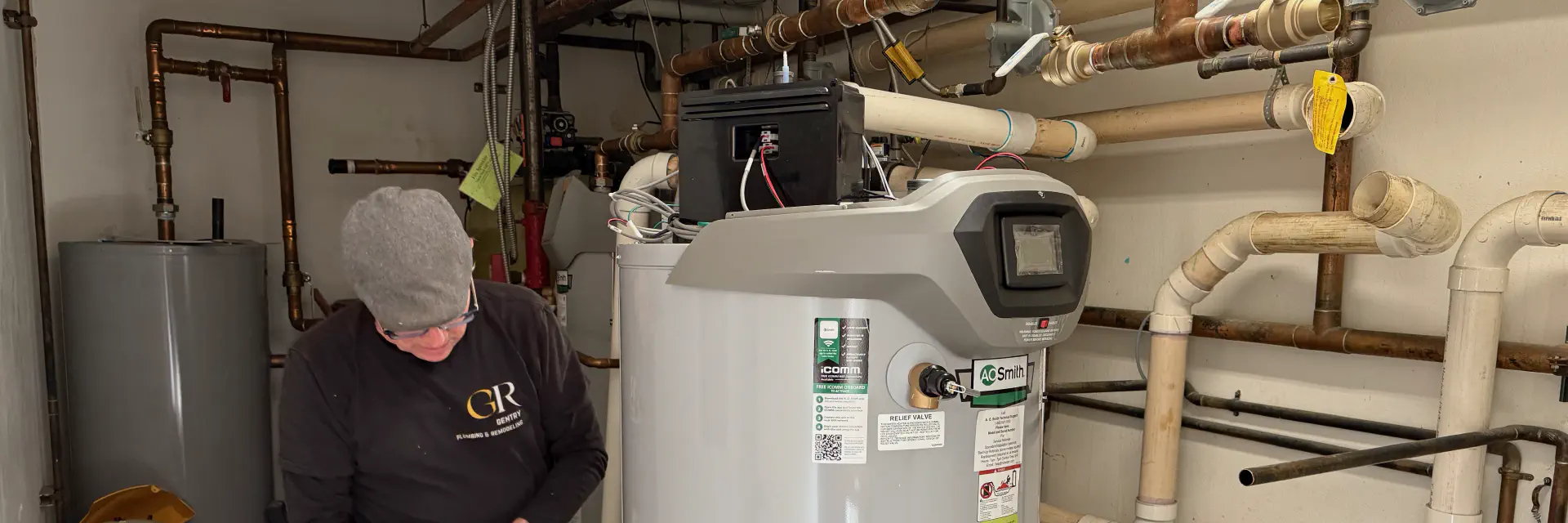
Water Heater Repair & Replacement for East Valley Homes
The average East Valley water heater works harder and dies sooner than it should. Hard water is the reason, and most homeowners find out only when they’re standing in a puddle. Here’s what you need to know to make a good decision, whether you’re replacing an emergency failure or planning ahead.
Tank vs. Tankless in Hard-Water Country
The honest answer is that both technologies work well when they’re matched to the right home and maintained correctly. The mistake is treating it as a pure efficiency calculation without accounting for local water quality.
Tank water heaters store a set volume of hot water — typically 40 to 80 gallons for residential use — and reheat it continuously. They’re straightforward, repairable, and replaceable fast when they fail. The efficiency penalty comes from standby heat loss: the tank is always maintaining temperature whether you’re using hot water or not. In the East Valley, scale accumulates on the tank bottom and acts as insulation between the burner and the water, forcing the unit to run longer to reach setpoint, which accelerates wear and increases gas or electric consumption.
Tankless water heaters heat water on demand through a heat exchanger and have no standby loss. They’re more efficient per gallon heated and, in a properly sized install, deliver endless hot water. The East Valley complication: hard water will scale a tankless heat exchanger faster than a tank bottom. Many manufacturers require annual flushing to maintain warranty coverage, and in our area that’s a real maintenance commitment, not a checkbox.
The practical decision tree:
| Situation | Better Fit |
|---|---|
| Emergency failure, no hot water today | Tank — same-day swap possible |
| Have a water softener or planning to add one | Tankless is a strong option |
| No softener, no interest in adding one | Tank — with annual maintenance |
| Larger home with high simultaneous demand | Size carefully — tankless flow rate matters |
| Conditioned garage or utility space, lower electric rates | Heat pump water heater — most efficient option |
| Tight utility space, no 240V circuit available | Tank — fewer installation constraints |
Why East Valley Water Heaters Die Early
This is the piece most plumbers don’t take the time to explain.
East Valley municipal water runs hard — Gilbert averages 13 gpg, Mesa peaks at 25 gpg, Tempe groundwater blends hit 33 gpg. (See East Valley water quality data for a full breakdown by city.) Nationally, a tank water heater should last 10–12 years. In our service area, we see them failing at 6–8 years. Two overlapping causes:
Scale accumulation. Calcium and magnesium precipitate out of hot water and settle on the tank floor and heating elements. The layer acts as insulation, forcing the burner or element to work harder and longer to heat through it. The tank runs hotter at the bottom, cycles more frequently, and wears out the thermostat and heating elements prematurely. In gas units, sediment trapped at the bottom creates hot spots that stress the tank steel.
Anode rod neglect. This is the one most homeowners never hear about. Every tank water heater has a sacrificial anode rod — typically magnesium or aluminum — that sits in the tank and corrodes in place of the steel walls. It’s engineered to be consumed so the tank isn’t. When the rod is fully depleted, the tank itself begins corroding from the inside. In the East Valley’s hard water, anode rods deplete faster than the national average. A rod that might last 4–5 years in soft-water Phoenix suburbs can be consumed in 2–3 years here. Most homeowners don’t know their tank has one. Most plumbers who install a unit never mention it again.
The fix isn’t complicated: inspect the anode rod on a schedule, flush the tank annually to remove sediment, and add a water softener if you haven’t already. A softener significantly extends water heater life across all technologies — tank, tankless, and heat pump — because it removes hardness before the water ever reaches the heater.
Sizing for Your Household
An undersized water heater runs out during morning showers. An oversized one wastes energy heating water you’re not using. Neither failure is expensive to avoid with the right conversation upfront.
For tank water heaters, first-hour rating (FHR) — the number of gallons the unit can deliver in the first hour of use — is more useful than tank capacity alone. Household size, morning routine, and simultaneous fixture demand all feed into the right size.
For tankless, flow rate in gallons per minute (GPM) and temperature rise are the key variables. In the East Valley, groundwater enters homes at roughly 65–75°F in summer and cooler in winter. A unit rated for a 70°F temperature rise at a given GPM may underperform in January. We size for worst-case inlet temperature, not average.
We’ll ask about your household and walk you through the math before recommending a unit.
Gas, Electric, or Heat Pump
Most East Valley homes have an existing fuel source that determines the starting point — swapping from gas to electric or vice versa adds cost and sometimes requires permits for gas line or electrical panel work. Within a fuel type, the decision is more nuanced:
Gas (natural gas or propane) heats water faster and typically costs less per BTU in Arizona. Standard atmospheric-vent and power-vent tank units are the most common replacements we do. Condensing gas tankless units achieve high efficiency but require proper venting; not every utility space accommodates them without modification.
Electric resistance (standard electric tank) is simpler to install where a 240V circuit exists. Operating cost is higher than gas at current Arizona utility rates. These are a straightforward, reliable option when gas isn’t available.
Heat pump water heaters use a refrigeration cycle to move heat from the surrounding air into the water rather than generating heat directly — similar to how an air conditioner works, in reverse. They’re two to three times more efficient than standard electric resistance. In the East Valley, conditioned garages and utility rooms provide the ambient air the heat pump needs to work effectively. They require more installation space than a standard tank and a 240V circuit, and they produce cool, dehumidified air as a byproduct — a minor advantage in a hot climate. We install the latest heat pump water heater technology and can walk you through whether your space is a good fit.
Tankless Flushing — the Maintenance Most Owners Don’t Know About
A tankless water heater is a precision appliance. The heat exchanger — a network of narrow passages where water is heated rapidly — is exactly the place where dissolved calcium and magnesium want to deposit. In hard East Valley water, scale builds measurably within a year of operation.
Annual flushing is non-negotiable here. The process involves circulating a descaling solution (typically dilute white vinegar or a citric acid solution) through the heat exchanger to dissolve mineral buildup. Skipping it reduces efficiency, and many manufacturers explicitly require documented annual maintenance to honor the warranty. We’ve seen warranty claims denied on units that were under five years old because maintenance records weren’t kept.
If you have an existing tankless unit that hasn’t been flushed in more than a year, that’s where we’d start. A properly maintained tankless heater in the East Valley is a good investment. An unmaintained one is an expensive lesson.
The combination that makes tankless genuinely low-maintenance: a whole-house water softener upstream. Soft water reduces heat exchanger scale dramatically and can extend flushing intervals — though we still recommend annual inspection.
Recirculation Pumps
Larger Mesa and Gilbert homes — and many newer builds in Queen Creek and San Tan Valley — have long pipe runs from the water heater to the master bath or kitchen. The result is a familiar complaint: waiting 60–90 seconds for hot water while cold water runs down the drain.
A recirculation pump solves this by keeping hot water moving slowly through the line and returning cooled water to the heater before it’s wasted. Timer-based and on-demand (push-button or motion-activated) systems are both available. The on-demand approach uses less energy than a continuous-loop setup and can be retrofitted without dedicated return lines using a crossover valve at the fixture.
If this is a complaint in your home, mention it when you call. We can integrate a recirculation setup during a new installation or add one to an existing system.
Repair vs. Replace: An Honest Decision Tree
We don’t default to replacement. A water heater with a failed element, bad thermostat, failing pressure relief valve, or deteriorated dip tube is often worth repairing — especially if the tank is under 8 years old and in otherwise good condition.
The factors that shift the answer toward replacement:
- Tank is leaking at a seam or the bottom. Internal corrosion has reached the tank wall. There is no repair for this.
- Unit is 10+ years old. Even if the current problem is repairable, the age of the unit means more failures are likely. It may not be cost effective to repair
- Efficiency standards have changed since the unit was installed. Newer units may qualify for utility rebates .
- Fitting or connection is leaking. Typically repairable. Fittings, supply lines, and pressure relief valves are external components — the tank itself may be fine.
We’ll give you an honest read on the specific failure before recommending a path. If repair makes sense, we’ll say so. See plumbing repairs for general repair work beyond water heaters.
Same-Day Tank Replacement
For standard tank sizes, we carry the equipment and can typically complete a replacement the same day you call. If you have no hot water and an emergency isn’t a viable option to postpone, call (480) 220-1266 and we’ll give you a straight timeline on availability.
For plumbing emergencies that extend beyond the water heater — flooding, ruptured lines, or damage from a failed unit — we handle those under the same call.
Tankless and heat pump water heater installs have longer lead times due to equipment sourcing and, in some cases, venting or electrical prep work. We’ll tell you exactly what the timeline looks like during the initial call.
Permits and Code (Maricopa and Pinal Counties)
We pull permits for every water heater installation in Maricopa and Pinal counties. It’s required by code, and we don’t skip it.
Permit-free installs are unfortunately common in this industry. The problems surface later: failed inspections at resale, issues with homeowner’s insurance claims after water damage, and in some cases code-required upgrades that become much more expensive to address after the fact.
A permitted installation means a licensed inspection, a record that the work was done correctly, and no surprises when you sell the home. Our licenses — ROC #327364 (CR-37 Plumbing) and ROC #332463 (B-3 General Remodeling) — cover the full scope of water heater installation and any associated remodeling work.
Warranty: Manufacturer warranty applies to the equipment and varies by product. Our installation warranty covers the workmanship; terms are fully disclosed in your quote before any work begins.