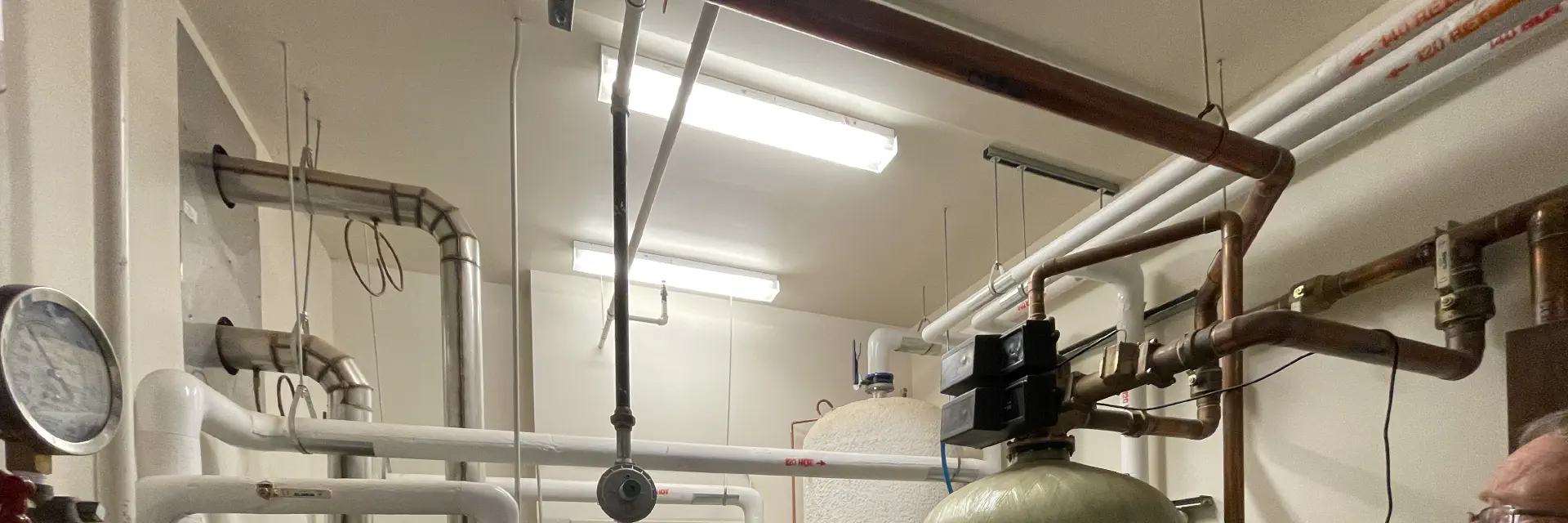
Water Softener Installation for East Valley Homes
East Valley tap water is some of the hardest in the country. Gilbert averages 13 grains per gallon (gpg) and spikes to 20.7. Mesa peaks at 25 gpg. Tempe’s groundwater blends hit 33 gpg. San Tan Valley and Scottsdale run 15–18 gpg year-round. Nationally, water above 10.5 gpg is classified as “very hard.” Most of our service area runs well past that line, and the damage compounds over time in your pipes, water heater, fixtures, and appliances.
A properly sized and installed water softener is the direct solution. Here’s what you need to know before you buy one.
Why East Valley Water Demands a Softener
Hardness is measured in grains per gallon (gpg) or milligrams per liter (mg/L). One gpg is 17.1 mg/L. The U.S. Geological Survey classifies water above 10.5 gpg as “very hard.” Here’s where our cities land:
| City | Hardness Range (gpg) | Classification |
|---|---|---|
| Gilbert | 6.3–20.7 (avg 13) | Very Hard |
| Chandler | 10.1–16.8 | Very Hard |
| Mesa | 0.5–25 (peak 25) | Very Hard to Extreme |
| Scottsdale | 13–17 | Very Hard |
| Tempe | 9.9–33 (groundwater 33) | Very Hard to Extreme |
| Phoenix | 9.2–20.1 | Hard to Very Hard |
| Queen Creek | ~6.4–15.2 (avg 12) | Hard to Very Hard |
| San Tan Valley | 15–18 | Very Hard |
Hardness also varies seasonally. Cities blend surface water (Colorado River) and groundwater depending on availability. When groundwater draws increase in summer, hardness spikes — Tempe’s 33 gpg peak happens during these blending periods. A system that’s performing at the margins in spring may be undersized by August.
How Ion Exchange Actually Works
A water softener’s core is a resin tank filled with millions of tiny resin beads coated with sodium ions. As hard water passes through, calcium and magnesium ions — which carry a stronger positive charge — displace the sodium ions and bond to the resin. The outgoing water carries sodium instead of calcium and magnesium: soft water.
Over time, the resin saturates with calcium and magnesium and can no longer exchange. The system triggers a regeneration cycle: a concentrated brine solution flushes through the tank, knocking the calcium and magnesium off the resin and flushing them to the drain. The resin is recharged with sodium and ready for the next cycle.
The result is water with no measurable hardness — zero scale on fixtures, no mineral buildup inside your water heater, no chalky film on dishes.
Salt-Based vs. Salt-Free Alternatives: Honest Trade-offs
The water treatment industry markets several technologies as “salt-free softeners.” Two are common in the residential market: Template Assisted Crystallization (TAC) and chelation systems that inject a citric acid sequestrant. Both have real use cases. Both have real limitations in East Valley conditions, and neither actually softens your water the way ion exchange does.
Salt-based ion exchange:
- Physically removes calcium and magnesium from the water
- Delivers measurably soft water at every outlet
- Prevents scale in pipes, appliances, and the water heater
- Improves lathering, skin feel, and hair
- Effective at any hardness level
- Maintenance: salt top-off three or four times a year
TAC conditioner (salt-free):
- Changes the crystalline structure of hardness minerals so they don’t adhere to surfaces
- The hardness minerals remain in the water; the water is still chemically hard
- Does not improve soap lathering, skin feel, or hair
- No salt, no regeneration, no wastewater discharge
- Effectiveness drops significantly above roughly 18 gpg
- Maintenance: media replacement every several years
Chelation / citric acid sequestration (marketed as Nuvo H2O and similar):
- Injects a chelating agent, typically citric acid, that binds with calcium and magnesium ions and keeps them suspended in solution rather than depositing as scale
- The hardness minerals stay in the water; the water remains chemically hard, the same limitation as TAC
- Does not improve soap lathering, skin feel, or hair
- No salt, no regeneration, no electrical, no drain
- Slightly lowers the water’s pH, worth thinking about in homes with copper supply lines that already deal with East Valley chloramine pinhole corrosion (see Repipes)
- Manufacturer hardness ratings vary by configuration; performance at the upper end of East Valley supply hardness is unreliable
- Maintenance: cartridge replacement roughly every six months
That hardness ceiling matters for the East Valley. Mesa peaks at 25 gpg. Tempe hits 33 gpg. Scottsdale and San Tan Valley run 15–18 gpg, right at the margin where these systems start to struggle. Because municipal hardness varies with seasonal water blending, a TAC or chelation system that performs adequately in winter may fall short in summer when hardness climbs.
The maintenance reality is also worth weighing. Three or four bags of salt a year, dumped into a brine tank, is genuinely lower-effort than disassembling a cartridge housing every six months and swapping a sequestration filter. Cartridges cost more per year than salt as well.
We’re happy to install salt-free systems. For most East Valley addresses at peak hardness, salt-based ion exchange is the more reliable choice.
Sizing for Your Household
Grain capacity is the measure that matters. A softener sized too small regenerates constantly: you burn through salt fast, the resin never fully recovers between cycles, and you don’t get consistent soft water. A softener sized too large sits idle too long between cycles, which allows the resin to pack and degrade.
We size to three variables:
- Household water consumption — number of people, usage habits, irrigation if it runs through the softener loop
- Supply zone hardness — using your city’s reported range, weighted toward peak seasonal values
- Regeneration cycle — how frequently the system needs to regenerate to maintain capacity
We run the calculation before recommending a system. There’s no single “right size” that applies to every home.
What Softening Actually Changes
The effects of genuinely soft water are noticeable within days. Here’s what changes and why.
Showers and skin. Hard water leaves a thin film of calcium and soap scum on skin. With soft water, soap rinses completely, skin feels different within the first shower, and hair regains its natural texture.
Laundry. Hard water bonds with detergent, forming insoluble compounds that don’t clean and don’t rinse out. Soft water lets detergent do its job; most households use 30–50% less and get cleaner results. Fabrics come out softer and last longer without the mineral abrasion that hardens and fades fibers over time.
Dishes and glassware. The white spots on glasses and dishes are dried mineral deposits, not residue from your detergent. Soft water eliminates them at the source.
Water heater life. Scale builds inside a water heater’s tank and heating elements, acting as insulation that forces the heater to work harder to reach temperature. Over time it accumulates into a thick layer that significantly shortens heater life. A softener is the most effective protection for a water heater in a hard-water region, and we frequently see the evidence of what happens to unprotected heaters at 7–10 years in East Valley homes.
Faucets and showerheads. The chalky white buildup on aerators and showerheads is calcium and magnesium. It restricts flow and traps bacteria. Soft water stops the accumulation. Existing buildup on older pipes and fixtures often reflects years of mineral damage that is already done; a softener prevents further accumulation.
Soap and detergent use. Soft water lathers significantly more efficiently. Most households find they use 30–50% less soap, shampoo, dish soap, and detergent after installing a softener. That reduction adds up in a household with multiple people over the course of a year.
What a Softener Doesn’t Solve
A softener is a single treatment stage. It’s the right tool for hardness and scale. It doesn’t address anything else.
A salt-based softener does not remove:
- Arsenic (Gilbert reaches the federal legal limit of 10.5 ppb)
- PFAS / forever chemicals (Tempe’s PFOS is 750% of the 2029 federal MCL)
- Nitrate (San Tan Valley at 93% of the maximum contaminant level)
- TDS (total dissolved solids — softeners exchange ions but don’t reduce dissolved solid load)
- Chlorine, chloramines, or disinfection byproducts
- VOCs or agricultural runoff contaminants
For those contaminants, you need different technologies. An under-sink reverse osmosis system is the only residential technology that reliably addresses arsenic, PFAS, nitrate, and TDS at the drinking tap. A carbon-stage whole-home filtration system handles chlorine and VOCs for the entire house. Most complete East Valley water treatment systems combine all three: sediment pre-filter, carbon filter, softener, and under-sink RO.
Pre-Plumbed Loops vs. Retrofit Installs
A soft-water loop is the plumbing configuration that routes softened water to indoor fixtures — showers, laundry, dishwasher, water heater — while leaving outdoor hose bibs and irrigation on untreated water. Softening outdoor water is unnecessary and wastes salt; a loop keeps softened water where it’s needed.
Many East Valley homes built before the late 1990s don’t have a pre-plumbed soft-water loop. Installers who only swap equipment — delivering and connecting a unit to an existing stub-out — can’t help you if the loop isn’t already there.
We can add a soft-water loop as part of the installation. It’s a plumbing rough-in: we run the loop through the home’s plumbing to properly route treated water to indoor fixtures and bypass outdoors. We can also rough in for a future under-sink RO at the kitchen sink during the same visit, which saves opening the walls twice.
Sodium Chloride vs. Potassium Chloride
Softeners require either sodium chloride (table salt) or potassium chloride to recharge the resin. The practical difference is smaller than marketing makes it seem.
Sodium chloride is the standard and the cost-efficient choice for most homes. The amount of sodium a softener adds to drinking water is small — typically 30–150 mg per liter depending on system design and hardness level — and not a health concern for the general population.
Potassium chloride is the right call when a doctor has flagged sodium intake for a household member on a medically restricted diet. It functions identically in the softener; it costs more per bag.
One note that changes the calculation: if the home has an under-sink RO at the kitchen tap, the distinction is largely moot. RO removes virtually all dissolved solids — including the sodium the softener adds. The practical recommendation for most East Valley homes is sodium chloride in the softener plus an RO system at the drinking tap. That combination covers both bases cleanly.
Maintenance: Salt and Annual Service
A well-maintained softener requires minimal ongoing attention.
Salt top-off: Typically every 4–8 weeks depending on household size, water hardness, and system capacity. You’ll notice the salt level dropping in the brine tank — most systems have a visual indicator. Keep the tank at least one-quarter full.
Annual service check: Once a year, we inspect the brine tank for salt bridges (crusted salt that blocks the draw), check the resin tank’s condition, test the control valve’s programming, and verify the regeneration cycle is correctly timed. Resin degrades gradually with heavy use in high-hardness zones — San Tan Valley and Mesa customers typically see this happen toward the lower end of the 8–15 year lifespan.
Warranty: Manufacturer warranty terms vary by product and are disclosed in the quote. We also cover our installation work separately — terms are included in your proposal.
Why Diagnostic Plumbing
We’re a locally owned company with deep familiarity with East Valley water — the city-by-city hardness variations, the seasonal swings, the homes that have loops and the ones that don’t. Our licenses cover the full scope of this work: ROC #327364 (CR-37 Plumbing), ROC #332463 (B-3 General Remodeling), and ROC #327365 (CR-61 Carpentry and Remodeling). That triple licensing matters when the job involves plumbing rough-in work like adding a soft-water loop, not just dropping in a unit.
We size every system to your household and your city’s water data. We don’t upsell capacity you don’t need. We’ll tell you honestly whether a TAC conditioner makes sense for your address or whether the hardness levels in your supply zone call for salt-based ion exchange. And we can coordinate a softener installation with an under-sink RO rough-in in a single visit, so your whole-home water treatment system comes together efficiently, not in three separate service calls.
Call us at (480) 220-1266 or request a free quote using the form below. We’ll go over your city’s water data, your home’s current plumbing configuration, and the right system for your situation.