Under-Sink RO Installation for East Valley Homes
Your Water Has Contaminates That Pitcher Filters CANNOT remove
Gilbert’s arsenic reaches the federal legal limit. Tempe’s PFOS is 750% of the 2029 federal MCL. San Tan Valley’s nitrate sits at 93% of the maximum contaminant level. No water softener, sediment filter, carbon filter, or salt-free conditioner removes any of these. Only one residential water treatment technology reliably addresses all three: reverse osmosis.
| Contaminant | Removal Rate | Why It Matters in the East Valley |
|---|---|---|
| Arsenic | 95%+ | Gilbert reaches the MCL (10.5 ppb); Chandler at 86% of MCL; no safe exposure level |
| PFAS / forever chemicals | 90%+ | Tempe PFOS at 30 ppt — 750% of the 2029 federal limit; PFAS detected in every East Valley city |
| Nitrate | 85–95% | San Tan Valley at 9.34 ppm (93% of MCL); particular concern for infants and pregnant women |
| TDS (total dissolved solids) | 90–99% reduction | Gilbert avg 795 ppm; Mesa peaks at 970 ppm; EPA secondary standard is 500 ppm |
| Lead and heavy metals | 95%+ | Aging service lines; no safe level for lead; chromium-6 and barium also addressed |
| Chlorine and chloramines | Yes (carbon stage) | Taste, odor, and disinfection byproduct precursors throughout the service area |
| VOCs and disinfection byproducts | Yes (carbon stage) | Chandler TTHMs at 81% of MCL; VOCs from agricultural and industrial activity |
| Hardness (at the drinking tap) | Yes | Eliminates scale in kettles, coffee makers, and ice machines |
How Reverse Osmosis Works
A reverse osmosis membrane has pores small enough to exclude virtually anything that isn’t water — approximately 0.0001–0.001 microns. Water is forced through the membrane under household pressure, and dissolved minerals, metals, and chemicals — arsenic, PFAS, nitrate, lead, chlorine, and dissolved solids — stay behind and are flushed to the drain.
A residential RO system is a staged process, not just the membrane:
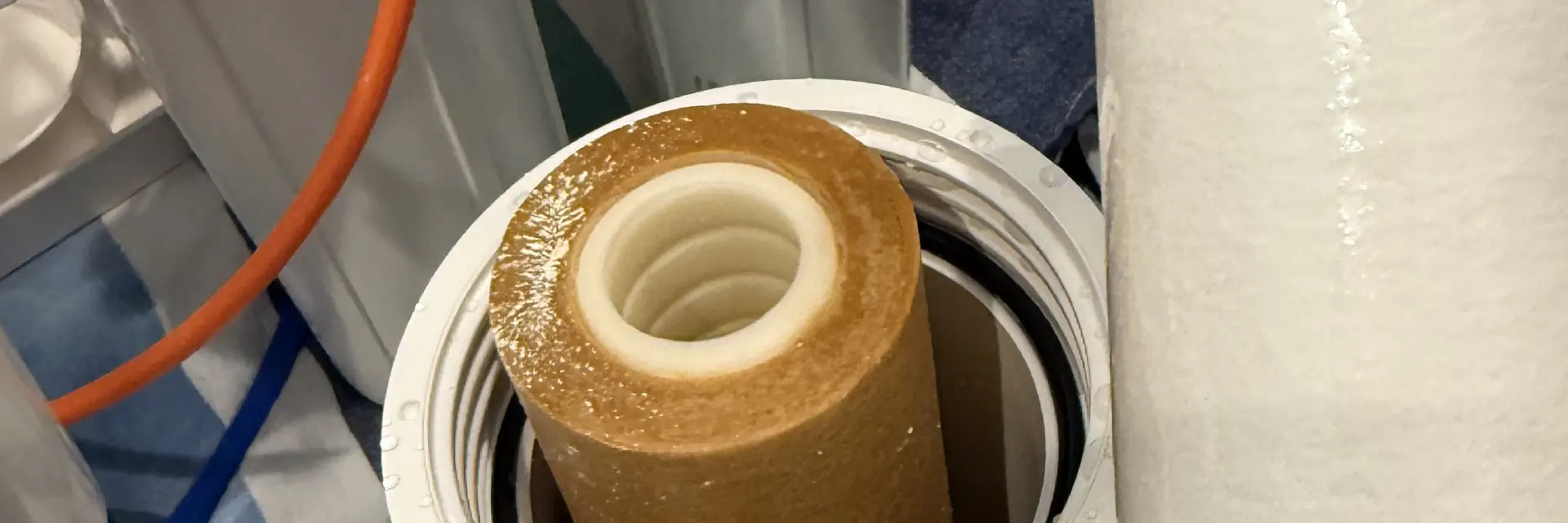
- Sediment pre-filter — removes particles, rust, and sediment that would wear down the membrane
- Carbon pre-filter(s) — removes chlorine and chloramines, which degrade the membrane over time
- RO membrane — the core filtration stage; rejects 90–99% of dissolved contaminants
- Pressurized storage tank — holds filtered water so it’s ready on demand
- Carbon post-filter (polishing stage) — a final pass to polish stored water before it reaches your faucet
What Reverse Osmosis Removes
A note on arsenic and chlorination: Some argue that RO is less effective against arsenic III (trivalent arsenic). This is technically true in unchlorinated water. Because East Valley municipal water is chlorinated, a significant portion of arsenic III is oxidized to arsenic V — which RO removes at 95%+. This is not a meaningful limitation for city water customers in our service area.
Under-Sink RO and Whole-Home Filtration
These aren’t competing options — they solve different problems and work best together.
Whole-home filtration (sediment, carbon, and softener stages) treats every gallon that enters the house. These systems do important work, but none of them touch arsenic, PFAS, or nitrate. Not even partially. If you have an existing system and want confirmation, we’ll test your water.
Under-sink RO picks up where whole-home filtration stops. It installs in the cabinet under the kitchen sink, delivers purified water through a dedicated faucet, and reduces TDS by 90–99%, removes arsenic at 95%+, and eliminates PFAS and nitrate. It treats the water you drink and cook with — the water that actually enters your body.
A whole-home filtration system is not a substitute for RO. The contaminants that make East Valley water genuinely concerning — arsenic near the legal limit, PFAS well above upcoming federal limits, nitrate approaching the MCL — require a membrane. Chlorine removal and scale prevention are valuable, but they don’t get you there.
The right setup for most East Valley homes is both: whole-home filtration for plumbing and appliances, under-sink RO for drinking and cooking water. See Whole Home Filtration for how the treatment stages stack together, and Water Softeners for detail on hardness and scale protection.
Filter Maintenance Schedule
An RO system lasts for years with routine filter changes. Skipping maintenance — particularly on the pre-filters — shortens membrane life and degrades water quality.
| Stage | Replacement Interval |
|---|---|
| Sediment pre-filter | Every 6–12 months |
| Carbon pre-filter(s) | Every 6–12 months |
| RO membrane | Every 2–3 years |
| Carbon post-filter | Every 12 months |